Online grocery shopping has become a necessity. Today, many customers prefer ordering daily essentials through mobile apps. They want to buy fruits, vegetables, household items, dairy products, snacks and frozen food without spending time in long store queues.
This demand is growing fast in countries such as the USA, Canada and the UK. In these markets, customers are already used to quick delivery, smooth checkout, real-time order tracking and easy payment methods. Moreover, recent moves by major grocery brands show how competitive this industry has become.
As a result, many supermarkets, grocery stores, startups and delivery businesses are now planning to create their own grocery applications. However, before starting the project, the first question is usually the same:
What is the price of a grocery app development?
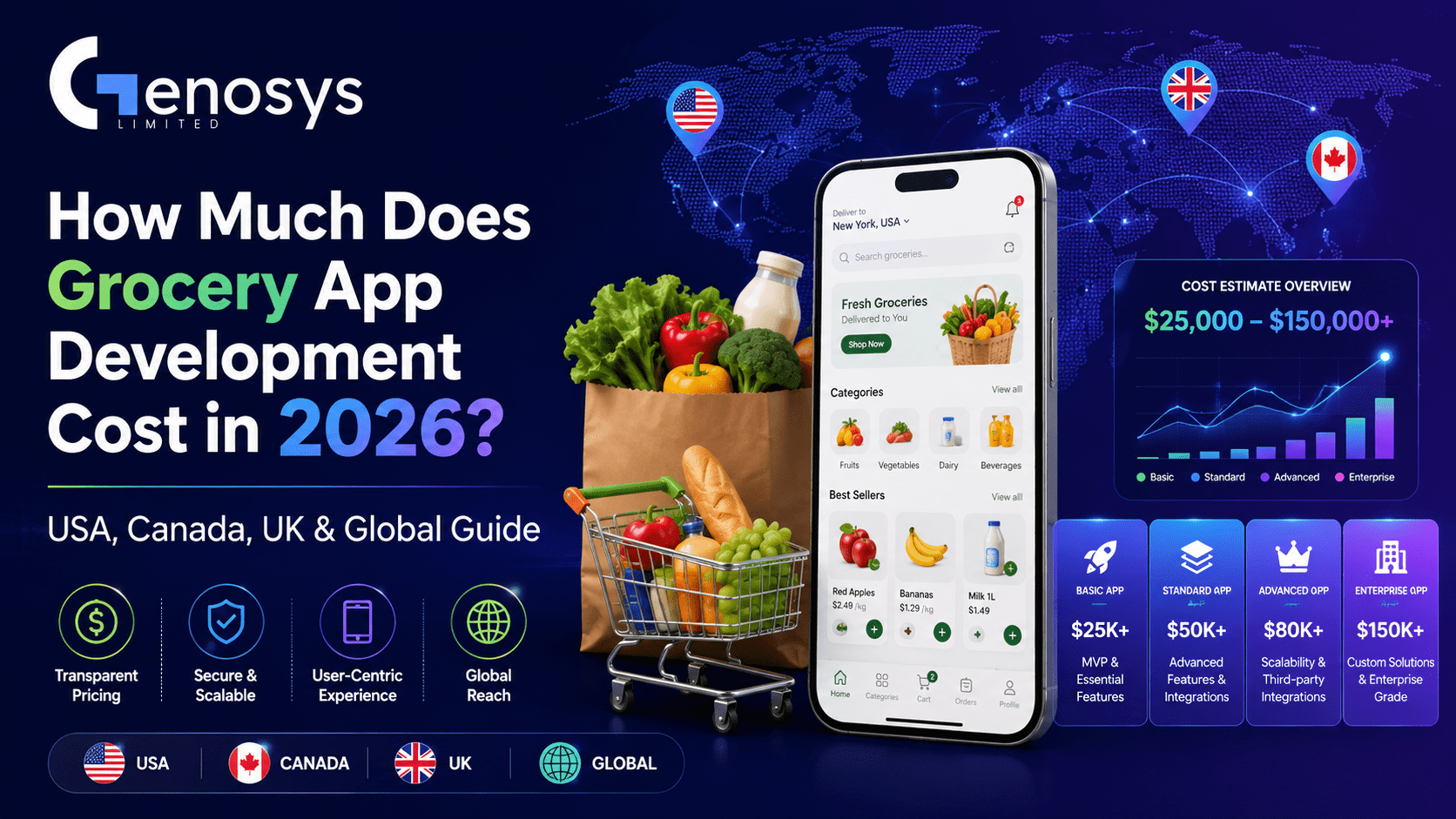
The answer depends on your app features, design, platform, business model, location and development team. In 2026, a basic grocery app can start from around $20,000 to $50,000. A mid-level app may cost around $50,000 to $100,000. However, a large grocery marketplace with advanced features can cost between $100,000 and $250,000 or even more. Overall, features, scalability and team location have a major impact on final pricing.
What is a Grocery App?
A grocery app is a mobile or web-based application that allows users to shop for groceries online. Through the app, customers can add products to their cart, place orders, pay online and receive delivery at their doorstep. In addition, some apps allow users to schedule delivery or choose store pickup.
In a complete grocery app, there are usually four major segments:
Customer app
Gather or sell panel
Delivery partner app
Admin dashboard
Customers use the app for shopping. The vendor panel helps store owners manage products, pricing, stock and orders. Meanwhile, the delivery app allows delivery partners to accept orders and update delivery status. Finally, the admin dashboard gives the business owner access to users, payments, products, delivery areas, coupons and reports.
Types of Grocery Apps and Their Costs
Basic Grocery App
Small grocery stores, local supermarkets or startups can benefit from a basic grocery app. It is ideal for businesses that want to test the market first.
Estimated cost: $20,000 to $50,000
Typical features include product listing, search, cart, checkout, payment gateway, order history, basic tracking and a simple admin panel. Therefore, this option is useful for businesses that want to launch quickly without adding too many advanced features at the start.
Mid-Level Grocery App
For businesses that require more functionality and control, a mid-level grocery app is more suitable.
Estimated cost: $50,000 to $100,000
This app may include a customer app, vendor panel, delivery app, admin dashboard, push notifications, discount codes, live order monitoring, real-time stock control, delivery control and basic analytics. In addition, it is ideal for companies targeting audiences in the USA, Canada, the UK, Australia, UAE or Europe.
Advanced Grocery Marketplace App
An advanced grocery app is ideal for companies that want to create a platform like Instacart, Amazon Fresh, Walmart Grocery or a multi-vendor grocery marketplace.
Estimated cost: $100,000 to $250,000+
This type of application may include multi-vendor support, AI product recommendations, subscription plans, loyalty points, route optimization, smart inventory, advanced reports, commission management and scalable cloud infrastructure. Because of these advanced features, the cost is higher and the app requires more planning, testing and backend development.
Grocery App Development Cost in USA
One of the most competitive grocery apps markets is the USA. Customers have high expectations regarding quick delivery, convenient ordering, secure payments and professional user experience. If you’re catering to New York, Los Angeles, Chicago, Dallas, Miami or Houston, your app should be reliable and scalable from the first day.
It may be more expensive in the USA due to higher expectations, compliance requirements and development speeds of users and the design quality as well. Real-time tracking, multiple payment options, fast checkout and smart search with high-performance backend are essential features of a serious grocery app for the United States.
Grocery App Development Cost in Canada
Canada is another robust market for online grocery and delivery solutions, too. Customers in cities, such as Toronto, Vancouver, Calgary, Ottawa and Montreal are used to online shopping and mobile orders.
If you are creating a grocery app for the Canadian market, your app needs to be neat, have scheduled delivery, secure payment system, ease of product search and reliable customer support. Bilingual support can also add to expenses if your company is geared toward both English and French speaking customers.
Grocery App Development Cost in the UK
Online ordering, delivery and click and collect services are not new to the UK grocery market. App users are looking for seamless app functionality, availability of delivery slots and easy checkout.
Key attributes for UK businesses include local delivery areas, postcode availability for service, integration with Google Maps, loyalty incentives, and secure payment and mobile-first design. Your business will need to be fast, modern, and trustworthy in the app if you want to compete in London, Manchester, Birmingham, Leeds or Glasgow.
Key Factors Affecting Grocery App Development Cost
1. Features and Functionality
The most significant cost is features. For example, a basic grocery app is cheaper because it includes only essential functions. On the other hand, an app with live tracking, vendor panels, delivery management, AI recommendations and advanced analytics is more expensive.
2. Android, iOS or Both
If you create separate apps for both iOS and Android, you could potentially spend more money. However, cross-platform development with Flutter or React Native can reduce costs because one codebase can serve both platforms.
3. UI/UX Design
Grocery apps should have a great design. Therefore, products should be easy to find, the cart should be simple to update and the checkout process should be smooth. If the design is not good, users may leave the application before making a purchase.
4. Backend Development
The backend manages orders, users, payments, stock, delivery, notifications and reports. For an app that supports many users and stores a lot of data, a strong and scalable backend is important.
5. Third-Party Integrations
Most grocery apps need payment gateways, Google Maps, SMS alerts, email notifications, push notifications, analytics tools and cloud storage. As a result, the more integrations you add, the more time and cost the project may need.
6. Maintenance and Updates
Once your app launches, it still needs updates, bug fixes, security support, server support and new features. For this reason, businesses should plan a monthly or annual maintenance budget.
It is essential that this grocery application has the following features:
The top grocery app will feature the following:
User registration
Product categories
Search and filters
Product details
Cart and checkout
Multiple payment options
Order tracking
Push notifications
Delivery address management
Ratings and reviews
Admin dashboard
Vendor panel
Delivery partner app
Coupons and discounts
Reports and analytics
Advanced apps include AI recommendations, loyalty deals, subscription options, barcode scanning, and route optimization and forecasting.
How to Reduce Grocery App Development Cost
The best way to control cost is to start with an MVP. MVP is the name given to minimum viable product, which means that you’re just including the most important features for the first time. Once the customer has started using the app it can be enhanced as required.
To reduce your expenses you can:
Start with the basic properties.
Use cross-platform development
Don’t overload with the bells and whistles when you first release it.
Use third-party APIs that are trusted.
Develop a basic, yet robust admin panel.
Take it to one city first!
Take the AI functions as an afterthought, if possible.
Take user feedback and implement Plans.
This not only will save you money, but it will also help you get your product to market faster.
How Genosys Limited Can Help
At Genosys Limited we assist companies in creating contemporary mobile applications, websites and digital solutions for expansion. Whether you’re based in USA, Canada, UK or anywhere in the world, you can build a grocery app that we can help you plan, design and build that is scalable and is able to achieve your business goals.
Mobile App Development, UI/UX Design, Admin Dashboard Development, Vendor Panel, Delivery App, Payment Integrations, Website Support, SEO and Digital Marketing Strategy are all things that we can help you with.
Call to Action
Looking to develop a grocery application for your business?
Turn your grocery idea into a reality by collaborating with Genosys Limited and create an easy-to-use, powerful and scalable application. We can help you create the perfect digital answer for your business here in the USA, Canada, UK and abroad.
Contact Genosys Limited today and start the development of your grocery app.
FAQs
To develop a grocery application, what are the costs?
Grocery app development can cost around $20,000 to $50,000 for a basic app, $50,000 to $100,000 for a mid-level app and $100,000+ for an advanced grocery marketplace.
How long will it take for your grocery app to be developed?
The time it takes to apply is 2-4 months. A mid level app will take 4-6 months or more, or an advanced app will take longer.
Can you develop a Groceries app for both the Android and iOS platforms?
It’s possible to build for both platforms! It can acquire expenses and improvement time with the cross platform development.
Does a food delivery app work for small business?
Yes, you can create a grocery store app with no bells and whistles and then add them in at a later date once the business picks up.
Can Genosys Limited develop a grocery app in the global markets?
Yes, Grocery applications are possible for Genosys Limited in the USA, Canada, UK and in the world.