
For any local business in Scotland, optimizing web speed in Edinburgh should be a key priority for 2026. Edinburgh has a busy local market, with restaurants, hotels, clinics, shops, tour companies, trades, and service businesses all competing for online leads.
When a customer visits your website, they expect it to load fast. If your site takes longer than three seconds, many people may leave and choose your competitor instead.
A slow website is not just a technical issue. It can reduce trust, harm local SEO, decrease sales, and stop visitors from filling out your contact form.
The Real Cost of a Slow Website for Edinburgh Businesses
A slow website can affect your business every day. Visitors may not wait. They might never see your services, prices, reviews, or contact details. This is a major concern because most customers compare websites before calling, booking, or requesting a quote.
High Bounce Rates and Lost Sales on the Royal Mile
Suppose a person is looking for a shop, restaurant, hotel, or tour around the Royal Mile. They click your website, but it takes too long to load. In a few seconds, they leave and open another site.
That visitor could have become a customer.
Slow speed can reduce contact form submissions, online bookings, product sales, phone call clicks, quote requests, and customer trust.
A fast website makes it easier for people to stay, read, and take action.
How Web Speed Directly Impacts Your Local SEO Rankings in Scotland
Website speed can also affect local SEO. Google wants to send users to helpful websites that provide information quickly. If your website is slow on mobile, your rankings may be affected.
This matters for searches such as Edinburgh services, local business in Edinburgh, best company in Edinburgh, and near me services.
If your competitors have faster websites, they may get more clicks and leads.
5 Common Reasons Why Your Edinburgh Business Website is So Slow
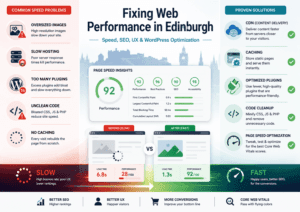
Most slow websites have more than one issue. These are the most common causes.
1. Unoptimized Images and Heavy Media Files
Large images can make your website very slow. Many business owners upload big images without resizing or compressing them.
To fix this, images should be compressed, resized properly, converted to WebP, lazy loaded, and optimized with SEO-friendly file names.
This can improve speed while keeping image quality high.
2. Poor Choice of Web Hosting for UK Audiences
Your website speed depends on your hosting. If your server is slow or not suitable for UK users, your website may load slowly.
UK businesses should use reliable hosting with fast response time, high uptime, and good support. Cheap hosting may cost more later because of lost leads and poor SEO.
3. Too Many Active WordPress Plugins and Messy Code
Many WordPress sites become slow because of too many plugins. Some plugins add extra scripts and styles on every page.
Messy code can also hurt performance. Legacy code, unused CSS, broken scripts, and heavy page sections can create slowdowns.
A good WordPress optimization strategy should include removing unnecessary plugins, optimizing code, and cleaning the database.
4. Lack of a Content Delivery Network
A Content Delivery Network, or CDN, helps your website content load from a server closer to the visitor.
This can help Edinburgh businesses that serve customers across Scotland, the UK, or worldwide. A CDN is useful for websites with many images, service pages, landing pages, or ecommerce products.
5. Outdated Legacy Themes and High Technical Debt
Old themes often cause speed issues. They may include extra code, outdated scripts, and poor mobile design.
Technical debt happens when your website has outdated fixes, weak structure, or old development work. Over time, this can make the site slower, less secure, and harder to use.
Step-by-Step Guide to Fixing Web Performance and Boosting Speed
Website speed should be fixed carefully. Installing random speed plugins may break your layout or forms. Start with testing, then solve the main problems one by one.
Run a Free Speed Test Using Google PageSpeed Insights
Use Google PageSpeed Insights to test your website. It shows what is slowing your site down.
Check mobile score, desktop score, Largest Contentful Paint, First Contentful Paint, Total Blocking Time, Cumulative Layout Shift, image issues, and JavaScript or CSS warnings.
This gives you a clear starting point.
Implement Browser Caching and Gzip Compression
Browser caching helps returning visitors load your website faster because some files are stored in their browser.
Gzip compression makes files smaller, so pages can load faster. These settings can improve images, CSS files, JavaScript files, fonts, and HTML files.
For WordPress sites, caching must be configured correctly. Wrong settings can break the design or contact forms.
Minify CSS, JavaScript, and Clean Up Database Bloat
Large CSS and JavaScript files may slow down your website. Minifying them removes unnecessary spaces and unused parts.
WordPress databases can also become heavy. Old revisions, spam comments, expired data, and unused tables may slow the website.
A complete speed fix may include CSS minification, JavaScript optimization, database cleanup, plugin audit, image compression, CDN setup, theme optimization, and Core Web Vitals fixes.
Looking for Professional Website Development Services in Edinburgh?
Making a website fast is a technical task. It is not just about installing one plugin. A slow website may need a full speed audit, hosting check, WordPress cleanup, UI/UX review, and code optimization.
Genosys Limited can help Edinburgh businesses improve website speed, local SEO, user experience, and conversions.
We can assist with full website speed audit, WordPress optimization, custom website redesign, image optimization, plugin cleanup, Core Web Vitals fixes, database optimization, mobile speed improvement, and technical SEO improvements.
A fast website can help your Edinburgh business build trust and get more leads. If your website is slow, Genosys Limited can offer a Free Web Performance & Speed Audit Consultation to identify and fix the main problems.