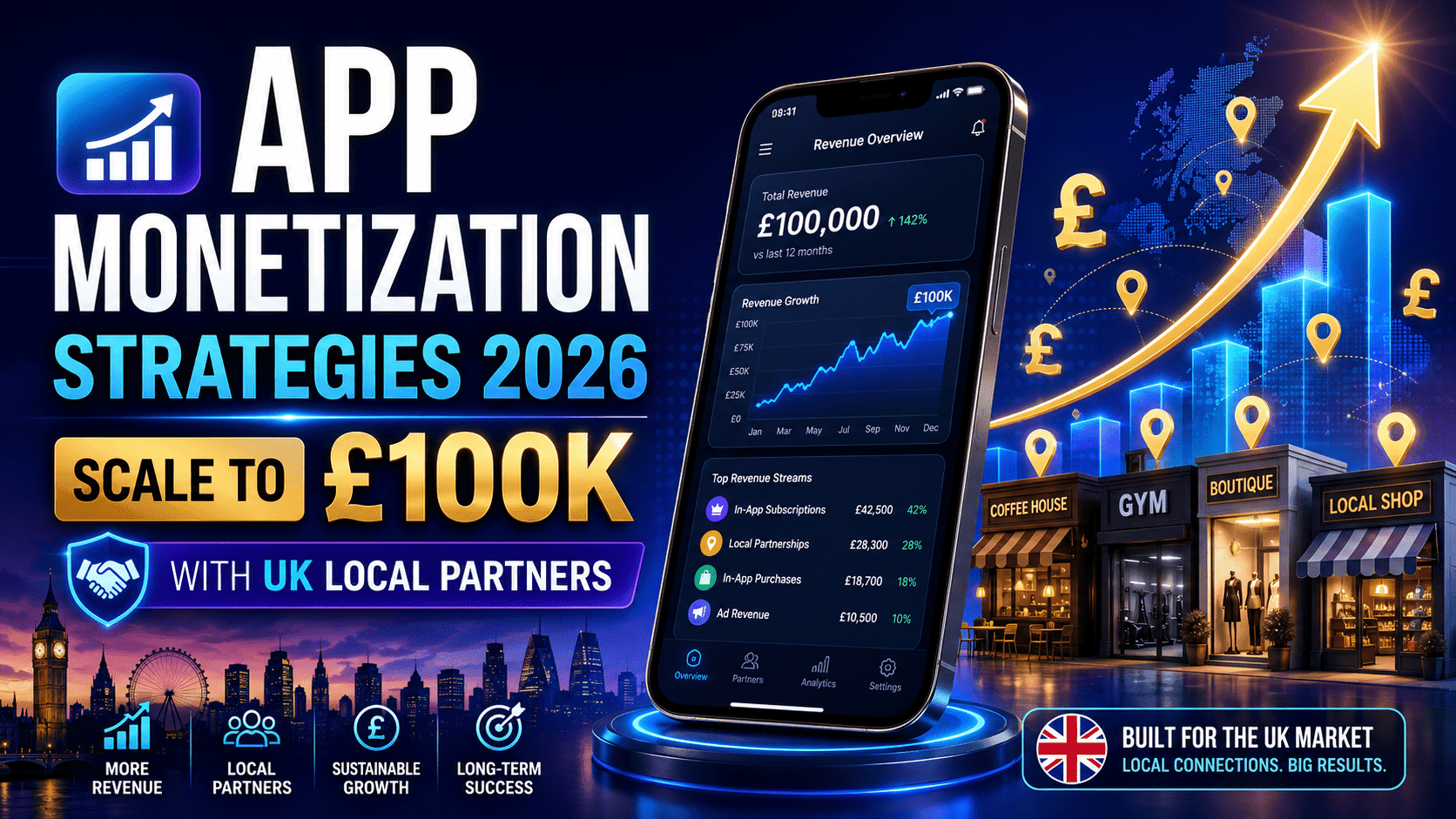
Introduction
Having 100k app users in the UK in 2026 can be a significant business asset. All these users are not just numbers. They are real people in real cities, such as London, Manchester, Birmingham, Leeds, Bristol, Glasgow, and Edinburgh. If your app is addressing a true need and has customers, then your local businesses may want to tap into that customer base.
There are still some app owners who rely on the old-fashioned ad network, such as AdMob or Unity Ads. They can be a viable option, but they tend to require lots of customers to generate a lot of profits. In the case of £100k revenue, you might need more than just banner ads and random display ads.
App monetization strategies 2026 are no longer only about showing ads. App owners now need smarter mobile app revenue streams, local partners, sponsored placements, and B2B app partnerships to grow faster.
The best approach is to combine app monetisation strategies with local B2B relationships in the UK. It involves collaborating with cafes, fitness centers, salons, stores, restaurants, clinics, and local businesses that desire a larger customer base from your user base. These hybrid app monetization models 2026 can help app owners build more stable income.
The objective is quite easy: leverage your traffic, audience and local influence to create direct revenue. This guide delves into the strategies startups, small businesses, and app owners can use to scale to £100k in 2026 with app monetization.
Quick Revenue Snapshot
Goal: Scale app revenue to £100k in 2026
Best Strategy: Mix local partners, sponsored listings, geo-fenced offers, affiliate deals and B2B app sponsorships.
Best For: UK apps with active users in London, Manchester, Birmingham, Leeds, Bristol and other local markets.
The 2026 UK App Landscape: Why Local Partnerships Matter
The UK’s app monetization is evolving. Users want to be kept more private, receive better offers and less intrusive ads. Small businesses also want to better connect with local customers in smarter ways.
This implies that it’s possible to get a great chance for apps with local people. If you have users in London, Birmingham, Manchester, Liverpool or Leeds, you can reach those users by connecting them with trusted local partners.
This is why UK local business app sponsorship is becoming a strong option for app owners. It helps apps earn from local partners while giving small businesses direct access to nearby users.
This model may be applicable for cities such as New York, Los Angeles, Chicago, Houston and Miami in the USA. Hyperlocal app monetization USA can work well when app owners connect local users with small business partners in their own city.
It might work in Toronto, Vancouver, Montreal, Calgary and Ottawa in Canada. App monetization Canada small business campaigns can also help local brands reach active app users through city-based offers. The same concept can also be implemented worldwide as long as there are strong local user groups.
The Decline of Standard Banner Ads and Low eCPMs
Banner ads are simple to add, but may not always generate a lot of income. A large number of users do not click on the banners. Some users also have ad blocking software or they can easily jump ads.
That is why many app owners are now seeking to move beyond the scope of the basic ads. Rather than serving up ads from all over the world, you can serve ads that are local, catering to the user’s interests and needs based on their city.
If you are a fitness app in Birmingham, you could have a connection with the gyms, supplement stores, healthy eateries, and personal trainers. A dating app in London can be integrated with restaurants, event venues, coffee shops and local experience providers.
In the USA, small business app advertising New York California can work for local shops, gyms, salons, restaurants and service businesses that want targeted users instead of random traffic. This model of app monetization may come across as more valuable than traditional ads at times.
Rise of Privacy Regulations: UK GDPR and Zero-Party Data
In 2026 privacy is a top priority. App owners need to be cautious of user data, particularly in the UK, USA, Canada and Europe.
The UK GDPR regulations put in place demands that businesses manage personal information securely and transparently. This data is more valuable as zero party data. Zero-party data is the data that users provide voluntarily; this includes preferences, interests, location preferences and favourite categories.
For instance, a shopper can search for “fitness deals in Manchester” or “coffee offers in Birmingham”. This will enable your app to display relevant local offers that won’t be a wild guess of sorts.
This is an effective approach for local business app monetization as the user receives offers that are relevant to them, and the local business partners receive top-quality leads. In Canada, geo-fenced app ads Canada can also help businesses in Toronto, Vancouver and Calgary promote offers to nearby app users.
Step-by-Step Blueprint to Scale to £100k with UK Local Partners
To scale app revenue, you need a clear plan. You cannot just add ads and wait for money. You need to understand your users, find the right partners, and create a strong offer.
To monetize 100k users app without ads, app owners need to build local partner packages, track user locations, and create offers that match each city.
1. Mapping User Demographics across UK Cities
First, find out where your users are located. View cities and regions.
Key UK city targets can be:
- London
- Manchester
- Birmingham
- Leeds
- Bristol
- Liverpool
- Glasgow
- Edinburgh
- Nottingham
- Sheffield
- Coventry
Other factors to consider are the user’s age, interests, activity level, and usage time for the app. For instance, users in London might be interested in more expensive events and restaurants. In Birmingham, users can be receptive to local food offers, gyms, salons or shopping deals.
If you’re in USA and Canada follow the same steps. Classify users according to city and interests. This will make it easier for you to construct superior partner packages.
2. Identifying High-Value Local Partners
Best local partners are businesses that require regular customers.
The following are good types of partners:
- Cafes
- Restaurants
- Gyms
- Salons
- Clinics
- High street retailers
- Local events
- Training centres
- Estate agents
- Travel companies
- Local service providers
A dating app can collaborate with eateries and event venues. A fitness app could work in conjunction with gyms and nutrition companies. Student app can work in collaboration with local training centres, bookstores and cafes.
It’s a great strategy for small business app monetization because local companies are typically looking for inexpensive marketing within their local community. UK local business app sponsorship can also help app owners generate direct revenue without depending only on low eCPM ads.
3. Pitching the Value Proposition to UK Small and Medium Enterprises
Don’t overcomplicate the offer when you reach out to local businesses. Do not sell “ads.” Offer local customers access for sale.
Your pitch can be:
We have active app users in Birmingham, who are similar to your target customer base, and can get your offer out and get local users to your business through the app.
Show them:
- Number of users in city
- User interests
- Monthly app activity
- Offer placement options
- Expected clicks or visits
- Simple monthly price
UK SMEs are after a clear value. They have to understand how your application can assist them to bring customers. This is where SME app marketing London Manchester can be useful because many small and medium businesses in these cities want affordable ways to reach local customers.
For example, SME app marketing London Manchester can help local cafes, gyms, salons, clinics, and retailers reach app users who are already active in their area.
Top Hybrid Monetization Models for 2026
A strong app should not depend on one income source. The best app monetization strategies in 2026 mix different models.
Hybrid app monetization models 2026 work best when sponsored listings, subscriptions, geo-fenced offers, affiliate commissions, and local business promotions are used together.
Model A: Sponsored Local Directories and Premium Pins
It’s possible to set up a local folder within the app. There’s the option of businesses paying to appear higher in the list.
For example:
- Birmingham is home to many excellent coffee shops.
- Best gyms in Manchester
- Best dating spots in London
- Local salons in Leeds
- Student deals in Bristol
For city based and maps, premium pins can be suitable. A business pays to be a featured location. This is one of the easiest mobile app revenue streams UK 2026 because local businesses understand directory listings and featured placements.
Model B: Geo-Fenced Push Notifications and Location-Based Deals
Geo-fencing means sending offers based on location. If a user is in the vicinity of a partner café, for instance, they can be sent a deal.
Example:
Today, pick up 15% off coffee close to Birmingham city centre.
This can be applied to the UK, USA, Canada and cities internationally. It’s beneficial because the offer comes to the user when they are near the business.
This method is also useful for location-based app monetization for small businesses because the offer is shown when the user is close enough to take action. Use this carefully. Too many push notifications can annoy users.
Model C: Affiliate or CPA Commissions on Local Store Foot Traffic
Affiliate/CPA monetization is when you make money when a user performs an action. This can be a booking, visit, purchase, signup or lead.
Examples:
- A gym pays £10 for each trial signup
- Table booking commission is the commission the restaurant receives for table bookings.
- Every appointment fee is covered by a salon.
- The costs of course enquiries are borne by a training centre.
This is a good app revenue model since it depends on results to pay local partners. It can also help apps monetize 100k users app without ads by using local partner commissions instead of relying only on banner ads.
Model D: Rewarded Video Ads Powered by Local UK Brands
Rewarded video ads will work if they provide value to users. Replace ads with offers by local brands.
Example:
“50 reward points if you watch this 20-second offer at a Birmingham gym.”
This can be used in gaming apps, dating apps, student apps, fitness apps and local deal apps.
Tech Stack Needed for Local App Monetization
To run local app monetization properly, your app needs the right tools. The tech stack does not need to be complex at the start, but it must support tracking, payments, and location-based features.
Geofencing and Location APIs
When you want local offers, maps and local targeting you might need location tools.
Common options include:
- Google Maps API
- Mapbox
- Firebase
- Location tracking tools
- Push notification tools
These tools enable to depict offers according to their location, city, or the surrounding businesses.
For instance, if someone is visiting Manchester, they will get offers from Manchester, and if someone is visiting Toronto, they will get offers from Toronto. This can also support local partner app advertising Toronto Vancouver when Canadian businesses want to promote deals to nearby users.
Subscription and Payment Management
If you are selling the premium placements, subscriptions or partner plans then you do need to have a payment system.
Common options include:
- Stripe UK
- RevenueCat
- Apple payments
- Google Play payments
- PayPal
- In-app purchase systems
Stripe UK can be helpful for B2B partnership plans because monthly payments can be made for sponsored placement or lead access by local businesses.
Case Study Example: From 100k Users to £100k Revenue
Let’s take an example that is simple.
You have 100k users in the UK for your app. London, Manchester, Birmingham, Leeds and Bristol are the strongest cities.
You elect to go the route of partnering with local groups. Each of these partners pays monthly for advertising their business within your application.
This is where a B2B mobile app sponsorship proposal template can help. It gives you a simple way to show local partners your user numbers, city reach, pricing and expected value.
The Math: How Many Local Partners Do You Need?
| Partner Type | Monthly Price | Partners Needed | Monthly Revenue |
|---|---|---|---|
| Small Local Partners | £50/month | 40 | £2,000 |
| Mid-Level Partners | £150/month | 20 | £3,000 |
| Premium Partners | £250/month | 15 | £3,750 |
| Total | Mixed Pricing | 75 Partners | £8,750/month |
You should be able to earn about £8,333 per month to earn £100k per year.
With £100 per month local contribution you require about 84 local partners.
With both partners paying £250 a month, this will require approximately 34 partners.
The target becomes easier when you combine small and premium partners.
Example:
- 40 small partners at £50/month = £2,000/month
- 20 mid-level partners at £150/month = £3,000/month
- 15 premium partners at £250/month = £3,750/month
Total: £8,750/month
Yearly revenue: £105,000
That’s why local partner monetization might be better than just using standard ads.
Tiered Pricing Structure for UK Businesses
Simple pricing plan(s) can be established for local business.
Basic Plan: £50/month
- Business listing
- Basic profile
- Contact button
- City category placement
Growth Plan: £150/month
- Featured listing
- Local offer placement
- Monthly push notification
- Basic performance report
Premium Plan: £250/month
- Top placement
- Geo-targeted offer
- Featured promotion
- Lead tracking
- Monthly report
This pricing might be suitable for the UK SMEs. City, industry and demand adjustments are available for pricing in the USA and Canada.
Conclusion and Next Steps
There is more to it than just traffic when it comes to growing an app to £100k in 2026. It’s not about the revenue model only. It’s about the right revenue model, and it’s about the right local partnerships.
Traditional ads can still work, but shouldn’t be your sole means of earning money. Better revenue can be generated through local business partnerships, sponsored listings, geo-fenced offers, affiliate commissions and premium placements.
Businesses might want to target these cities: London, Birmingham, Manchester, Leeds, Bristol, Toronto, Vancouver, New York, Chicago, or Los Angeles. If your app has users in these cities, you may already have an audience in a local market you’re interested in.
This is why app monetization strategies 2026 should include local partners, city-based offers, and small business sponsorships. Whether you are targeting the UK, USA, Canada, or other countries, local partner app advertising can help turn active users into steady revenue.
The best app monetization strategies 2026 focus on useful offers, local business partnerships, city-based promotions, and clear revenue planning.
Take a snapshot of your user data to audit it today. Research where your users live, what they do and what offers they might be interested in. Then create a quick-and-easy partner package for local businesses. Do not be afraid to try it and gauge the responses, and then gradually raise prices.
Want to Monetize Your App in 2026?
Genosys Limited can help you plan app monetization, local partner campaigns, sponsored listings and mobile app revenue strategies for UK businesses.